Building a Safe ColdFusion MX Lab

Recreate the MX-era development experience without turning unsupported software into a risk for your normal systems.

Do not place a legacy lab on your normal LAN or the public internet. Unsupported operating systems and application servers should be treated as intentionally vulnerable research systems.

Choose the Goal Before the Software

Period-Accurate Lab

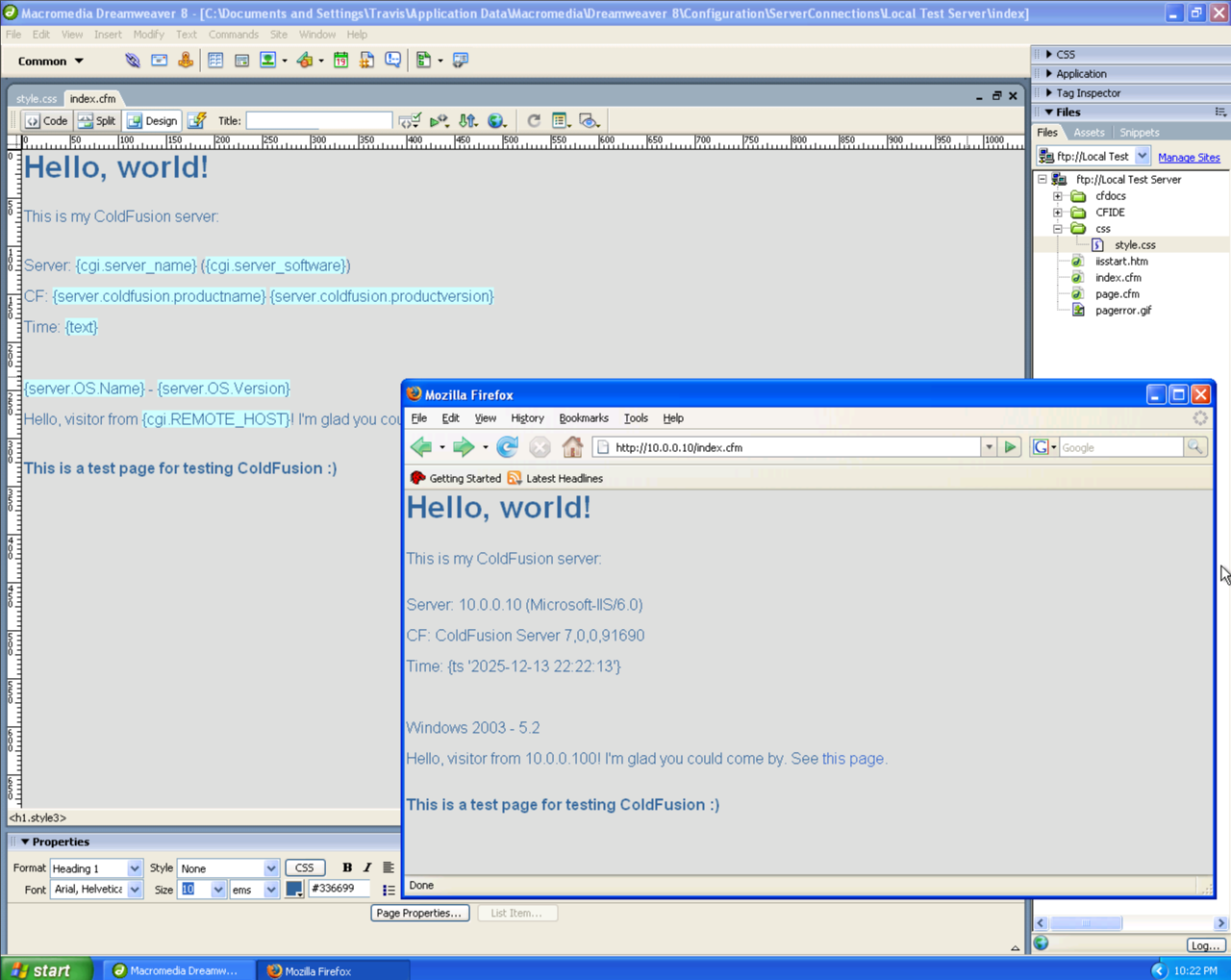
Use ColdFusion MX 7, Windows Server 2003, IIS 6, and Dreamweaver 8 to reproduce the workflow and constraints of the era.

Safe CFML Learning

Use a currently supported CFML engine on a current operating system, but write examples in the MX-compatible subset described in this section.

The second approach is safer for daily learning. The first is valuable for software preservation, screenshots, deployment archaeology, and understanding a recovered application in its original environment.

Recommended Network Design

Internet
   |
[Your normal router]
   |
[Host-only or isolated virtual switch]
   |--- cfmx-dev     192.168.77.10
   |--- cfmx-server  192.168.77.20
   `--- cfmx-db      192.168.77.30

No inbound port forwarding
No bridge to the production LAN
Temporary outbound access only when absolutely necessary

Build Checklist

  1. Create a dedicated virtual network. Prefer host-only networking or an isolated VLAN with explicit firewall rules.
  2. Install the guest operating system from legitimate media. Do not reuse passwords from any real account.
  3. Take a clean snapshot. Snapshot before installing IIS, ColdFusion, Java updates, database drivers, or development tools.
  4. Install the web server and ColdFusion. Record every installer choice, connector setting, service account, and path.
  5. Create a sample datasource. Use a database containing only disposable practice data.
  6. Disable unnecessary services. RDS, sample applications, remote administration, and development debugging should not be available beyond the isolated lab.
  7. Export or document the finished state. Preserve configuration notes separately from the virtual-machine image.

Suggested Lab Directory

C:\cfmx-lab\
|-- wwwroot\
|   |-- Application.cfm
|   |-- index.cfm
|   |-- customers\
|   `-- components\
|-- sql\
|   |-- schema.sql
|   `-- sample-data.sql
|-- notes\
|   |-- datasource.txt
|   |-- connector.txt
|   `-- patch-level.txt
`-- exports\

Information Worth Recording

AreaRecord
ColdFusionExact edition, version, updater, hotfixes, install mode, and service account.
JavaRuntime version, JVM path, heap arguments, and custom JAR files.
Web connectorIIS site, virtual directories, connector mappings, ports, and host headers.
DatasourceDSN, driver, database server, database name, username, and tested permissions.
ApplicationWeb root, mappings, custom-tag paths, scheduled tasks, and external dependencies.

Learning Without Running ColdFusion MX

You can still practice the important language concepts on a modern Adobe ColdFusion or Lucee installation while limiting yourself to MX-compatible syntax. That gives you current TLS, current Java, and a supported operating system while preserving the educational value of classic CFML.

Compatibility discipline: Avoid implicit array/structure literals, script components, member functions, closures, modern ORM, and newer tag-in-script syntax. Use the version reference on each page before assuming an example is MX-compatible.